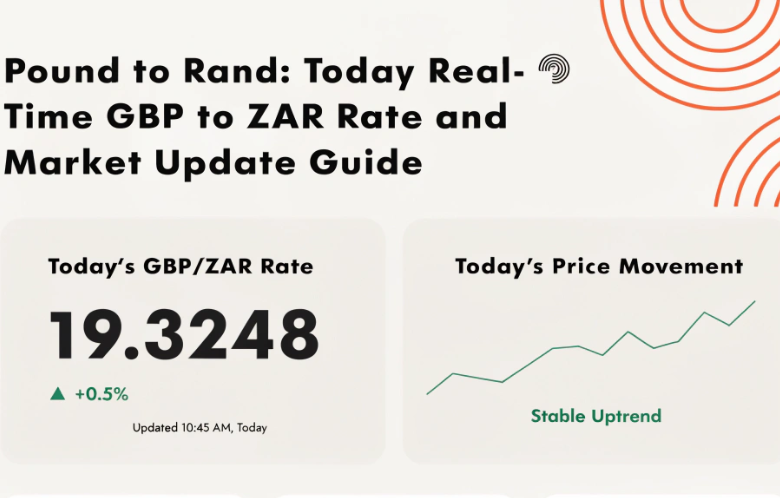
The pound to rand exchange rate is one of the most important currency conversions for people dealing with money between the United Kingdom and South Africa. It shows how much one British Pound (GBP) is worth in South African Rand (ZAR) and changes frequently due to global economic conditions, political events, and market demand. This exchange rate is widely used by travelers, businesses, investors, and individuals sending money internationally. Because both economies react differently to global financial changes, the rate can move up or down quickly. Understanding the GBP to ZAR movement helps you plan better, save money, and make smarter financial decisions.
What is Pound to Rand?
The pound to rand exchange rate refers to how much one British Pound is worth in South African Rand at a specific point in time. For example, if the exchange rate is 1 GBP = 22 ZAR, then one pound can be exchanged for twenty-two rand. However, this value is not fixed and changes continuously throughout the day depending on global forex market activity.
Currency exchange works through a decentralized global system where banks, financial institutions, governments, and traders buy and sell currencies. These transactions determine the real-time value of each currency. When demand for the British Pound increases, its value rises, meaning more rand is received for each pound. When demand for the rand increases or the pound weakens, the exchange rate falls.
It is also important to understand that the rate shown on websites or financial apps is usually the mid-market rate, which is the real-time global benchmark without fees. However, banks and exchange services add a margin or commission, which means the actual rate you receive may be slightly lower. This difference becomes more noticeable when exchanging larger amounts, making it important to compare providers before converting money.
How the GBP to ZAR Exchange Market Works
The GBP to ZAR exchange rate operates within the global foreign exchange market, which is the largest and most liquid financial market in the world. It runs 24 hours a day across different financial centers, including London, New York, and Johannesburg. In this market, currencies are continuously traded based on economic performance and investor expectations.
The exchange rate between the British Pound and South African Rand reflects the relative strength of both economies. When the UK economy shows strong growth, stable inflation, or higher interest rates, the pound tends to strengthen. On the other hand, when South Africa experiences economic improvements, increased exports, or political stability, the rand can gain strength.
Because the South African Rand is an emerging market currency, it is more sensitive to global events such as inflation changes, commodity price fluctuations, and geopolitical uncertainty. This makes the GBP to ZAR pair more volatile compared to major currency pairs, meaning its value can change rapidly within short periods.
Historical Behavior of Pound to Rand Exchange Rate
The pound to rand exchange rate has historically shown significant volatility due to differences between a developed economy and an emerging one. The British Pound is backed by a strong financial system and global investor confidence, while the South African Rand is more exposed to external economic pressures.
Over the years, the exchange rate has moved within a wide range influenced by inflation trends, interest rate changes, global recessions, and political developments. South Africa’s reliance on commodity exports such as gold, platinum, and minerals also plays a major role in shaping the value of the rand. When global commodity prices rise, the rand tends to strengthen, and when they fall, it weakens.
These historical patterns show that the GBP to ZAR exchange rate is not stable and requires continuous monitoring for anyone involved in financial planning or international transactions.
Key Factors That Influence Exchange Rate Movements
Several important economic and financial factors influence currency movements. Interest rates set by central banks are one of the most powerful drivers because they affect investment returns. When the Bank of England raises interest rates, the British Pound often strengthens due to increased investor demand.
Inflation is another key factor because high inflation reduces the purchasing power of a currency, making it weaker in global markets. Political stability also plays an important role, as uncertainty or policy changes can reduce investor confidence and lead to currency depreciation.
Global economic events such as financial crises, wars, or trade disruptions can also cause sharp fluctuations in exchange rates. In addition, commodity prices strongly impact the South African Rand because its economy depends heavily on exports of natural resources. All these factors combine to create constant movement in the exchange rate.
Currency Conversion in Real-World Practice
Converting currency from pounds to rand is a simple process, but the value you receive depends on where and how you convert it. The real-time market value is known as the mid-market rate, but most financial institutions do not offer this exact rate to customers. Instead, they apply a margin or service fee.
For example, if the market rate is 1 GBP = 22 ZAR, a provider might offer 21.5 ZAR per pound after fees. While this difference may seem small, it becomes significant when converting larger amounts of money. Timing is also important because exchange rates change throughout the day based on market activity.
Monitoring the rate and choosing the right moment for conversion can improve the total value you receive. Comparing different providers is also essential to ensure you are getting a fair deal.
Future Outlook of GBP to ZAR Exchange Rate
The future direction of this currency pair depends on economic growth, global market stability, and investor sentiment. If the UK economy remains strong with stable inflation and positive growth, the British Pound is likely to stay strong against the rand.
However, if South Africa improves its economic performance through increased exports, investment inflows, and stable policies, the rand may strengthen over time. Global uncertainty also plays a key role, as investors often move toward stronger and safer currencies during unstable periods.
Central bank decisions, inflation trends, and commodity price movements will continue to shape the future of this exchange rate. While exact predictions are not possible, analyzing these indicators provides useful insight into potential trends.
Importance of Exchange Rate Awareness
Exchange rates are important because they directly affect personal finance, business operations, and international trade. For individuals, they determine how much money is received when sending remittances or converting currency for travel. Even small fluctuations can significantly change the final amount.
For businesses, exchange rates impact import costs, export pricing, and profit margins. Companies involved in global trade must carefully manage currency risks to maintain financial stability. Investors and forex traders also monitor exchange rates closely because volatility creates opportunities for profit as well as risk.
Smart Tips for Better Currency Exchange
To get better value when converting currency, it is important to compare different providers before making a decision. Exchange rates vary across banks, online platforms, and money transfer services, so even small differences can affect the final outcome.
It is also important to avoid rushed conversions because rates can change quickly due to global news or economic updates. Monitoring the market over time can help identify better opportunities. Choosing transparent providers that clearly display fees ensures there are no hidden charges. By using a careful and informed approach, you can maximize value and reduce unnecessary losses.
(FAQs)
1. What is the pound to rand exchange rate?
The pound to rand exchange rate shows how much one British Pound (GBP) is worth in South African Rand (ZAR). It changes constantly based on global market demand, economic conditions, and political events.
2. Why does the GBP to ZAR rate change so often?
The GBP to ZAR rate changes because of supply and demand in the forex market, interest rate decisions, inflation, and global economic news that affects both the UK and South Africa.
3. Is the pound to rand rate fixed?
No, the pound to rand rate is not fixed. It fluctuates throughout the day depending on international trading activity and economic factors affecting both currencies.
4. What affects the pound to rand exchange rate the most?
Major factors include interest rates, inflation, political stability, commodity prices in South Africa, and overall global market sentiment.
5. When is the best time to convert pounds to rand?
The best time depends on market conditions. Many people monitor rates daily and convert when the pound is stronger or when the rand is weaker.
6. Do banks offer the same pound to rand rate as the market?
No, banks usually offer a slightly lower rate than the real market rate because they include service fees or profit margins in the exchange.
7. Can the pound to rand rate be predicted?
It cannot be predicted with full accuracy, but analysts use economic indicators, trends, and forecasts to estimate possible movements in the exchange rate.
Conclusion
The pound to rand exchange rate is a key financial indicator that reflects the economic relationship between the United Kingdom and South Africa. It is influenced by global market forces, economic performance, and political conditions, making it highly dynamic. Understanding how this exchange rate works helps individuals and businesses make smarter financial decisions and improve currency conversion outcomes. With proper awareness, timing, and strategy, you can reduce risk and get better value when exchanging GBP to ZAR.