Outdoor sports facilities are supposed to be community assets. School PE lessons, after-school clubs, weekend fixtures, casual evening kickabouts – these spaces underpin physical activity and social connection across the UK. But that only holds true when they’re actually usable.
The reality is that participation depends on reliability. When outdoor courts and multi-use games areas become waterlogged, cracked, or seasonally unusable, activity levels collapse. Sessions get cancelled, fixtures postponed, and eventually people stop turning up altogether. The investment loses its value.
In a climate where heavy rainfall is routine and seasonal variation is guaranteed, surface performance isn’t a technical footnote – it’s the determining factor in whether a facility gets used or sits empty for half the year. All-weather sports surfacing isn’t just a specification choice. It’s what makes consistent community participation possible.
The Impact of Downtime on Community Sport
Schools and local authorities work within fixed timetables and tight budgets. When outdoor facilities become unavailable due to poor drainage or surface deterioration, the disruption isn’t just inconvenient – it has measurable consequences.
For schools, cancelled PE sessions mean reduced curriculum delivery and fewer opportunities for physical activity. For community clubs, postponed fixtures disrupt league participation and erode volunteer commitment. In public parks, waterlogged courts discourage informal use and reduce overall footfall.
These interruptions carry both social and financial costs. Facilities that can’t be relied upon need more reactive maintenance, emergency repairs, or expensive alternative venue hire. Over time, this damages community confidence and makes the whole investment harder to justify.
Reliable surfacing eliminates most of these interruptions. Facilities remain usable across seasons rather than becoming write-offs whenever it rains.
Performance Characteristics of All-Weather Sports Surfaces
All-weather sports surfacing systems are engineered to maintain performance regardless of environmental conditions. In the UK – where rainfall is frequent and temperatures shift throughout the year – surface construction has to prioritise drainage, stability, and durability from the outset.
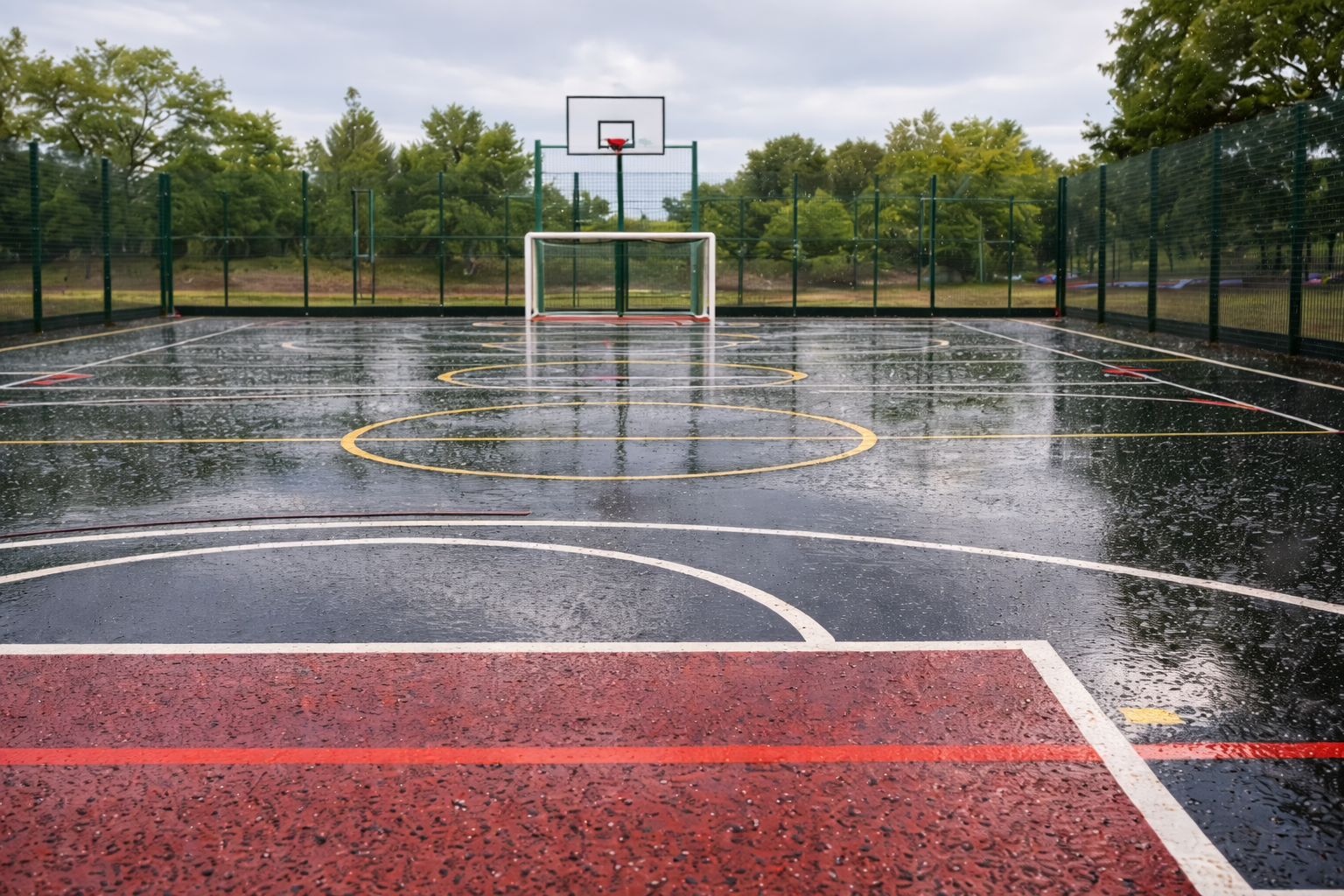
Well-designedpolymeric sports surfacing systems incorporate porous layers that allow water to drain through the surface structure rather than pooling on top. This drainage capability means faster return to play after rainfall and eliminates the slip hazards created by standing water.
Beyond drainage, performance requirements include:
- Consistent traction for multi-directional movement (crucial for ball sports)
- Structural integrity under daily high footfall
- Surface stability during temperature fluctuations
- Clear line marking that accommodates multiple sports
By delivering predictable footing and ball response year-round, polymeric surfaces maintain both safety and usability regardless of season.
Sport England’sActive Design guidance consistently emphasises the importance of designing environments that support ongoing participation rather than seasonal use. Surface reliability is central to that.
Supporting Schools and Multi-Use Games Areas
In schools, outdoor courts and multi-use games areas (MUGAs) are among the most intensively used facilities on site. On any given day, they might need to support:
- Timetabled PE lessons
- Break-time recreation (hundreds of children, limited supervision)
- After-school clubs
- Community lettings in the evening
- Holiday programmes during school breaks
A surface that becomes slippery, uneven, or waterlogged after moderate rainfall immediately limits all of these activities. Conversely, an all-weather surface with effective drainage and durable construction allows schools to maximise usage throughout the academic year without constant disruption.
For local authorities, multi-use design adds another layer of efficiency. A single polymeric court marked for netball, tennis, basketball, and five-a-side can serve a broad range of community needs without requiring additional land or infrastructure. That’s efficient use of space with genuine environmental and financial benefits.
TheAssociation for Physical Education consistently highlights the importance of providing safe, suitable environments for delivering quality physical education. Surface reliability is foundational to that aim.
Climate Resilience in UK Outdoor Design
The UK climate presents specific challenges that can’t be designed around – they have to be designed for. Heavy rainfall, frost, and seasonal temperature shifts – all of these affect surface longevity and performance.
All-weather polymeric systems are typically engineered with:
- Permeable surface layers to manage high rainfall volumes
- Structured sub-base construction to maintain stability
- Materials capable of withstanding freeze-thaw cycles without cracking
- Long-term resistance to surface wear from constant use
Without adequate drainage, repeated exposure to standing water accelerates deterioration and reduces playability. Similarly, inadequate sub-base preparation leads to surface movement or cracking within a few years.
Climate resilience isn’t an abstract sustainability goal – it’s a practical design requirement. Facilities that withstand environmental pressures need fewer reactive repairs and less frequent resurfacing. That translates directly into more efficient long-term management and lower whole-life costs.
Participation, Health, and Facility Reliability
Community participation is shaped heavily by perceived reliability. When players, parents, and schools know that a court or games area will be usable regardless of recent weather, engagement becomes consistent. When they don’t, attendance drops off and booking numbers decline.
All-weather surfaces maintain this confidence by reducing unexpected closures. For councils and schools investing in outdoor sports provision, that reliability strengthens the case for long-term funding and ongoing community use.
Sustainability in this context isn’t just about environmental credentials. It also includes social sustainability – ensuring facilities continue to support physical activity and community cohesion year after year, not just in summer.
The Role of Specialist Sports Surfacing Providers
Achieving dependable year-round performance requires more than selecting a surface material from a brochure. Drainage design, sub-base preparation, and installation standards all determine long-term outcomes.
Specialist providers like Novasport focus specifically on polymeric sports surfaces for schools, councils, and community facilities. By assessing site conditions, intended usage patterns, and environmental factors, specialist contractors help ensure surfaces remain durable, consistent, and fit for sustained use – not just compliant at installation.
Reliable infrastructure enables reliable participation. When surface design is approached with long-term performance in mind, facilities are far better equipped to withstand both environmental pressures and heavy daily use.
Building Active Communities Through Thoughtful Surface Design
Outdoor sports facilities represent a significant public investment. Their success shouldn’t be measured by how impressive they look on opening day, but by how effectively they support participation over the following decade.
All-weather polymeric sports surfacing systems contribute to year-round usability by combining drainage performance, structural durability, and multi-sport adaptability. In doing so, they reduce downtime, support consistent activity, and strengthen the long-term value of community infrastructure.
For schools and local authorities trying to encourage active lifestyles, surface reliability remains one of the most important – and most overlooked – foundations of sustainable participation.