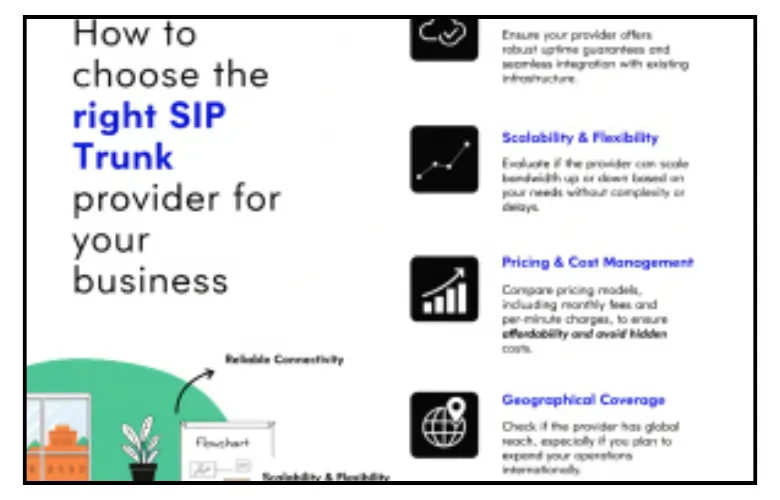
Call performance often breaks down outside internal systems. Routing failures, connection delays and dropped calls usually originate at the SIP Trunk provider level.
For teams running outbound sales, customer support or multi-region operations, a weak SIP Trunk provider leads to missed calls, lower answer rates and unstable campaign results. Even small routing inconsistencies affect how many calls turn into actual conversations.
Provider choice directly impacts ASR, call delivery and operational efficiency.
What a SIP Trunk provider does
A SIP Trunk provider connects PBX or cloud telephony systems to external telecom networks. All inbound and outbound traffic passes through this layer.
The SIP Trunk provider determines:
- how calls are routed across networks
- which carriers are used for each destination
- how traffic behaves under load
- how quickly calls are connected
Routing quality defines whether calls reach the destination or fail before connection.
Core services overview
A SIP Trunk provider typically provides:
- access to telecom routes across regions
- inbound and outbound call connectivity
- integration with PBX and VoIP systems
- traffic distribution across multiple paths
Within DID Global, call traffic is distributed across multiple routes instead of relying on a single path. This reduces dependency on individual carriers and maintains stable call delivery during peak periods.
Network reliability and uptime
Declared uptime does not reflect actual call performance. Even 99.9% uptime allows up to 40 minutes of downtime per month, which affects high-volume operations.
Routing stability has a stronger impact than uptime figures.
Unstable routing results in:
- dropped calls
- delayed connections
- missed inbound requests
- reduced answer rates
Redundancy and failover
A reliable SIP Trunk provider operates with:
- multiple routes per destination
- automatic failover between carriers
- traffic balancing based on performance
- continuous route monitoring
Single-route setups create a direct failure point. When that route degrades, call delivery drops immediately.
Multi-route routing keeps ASR stable even during traffic spikes or carrier issues.
Security and compliance
SIP infrastructure is exposed to fraud risks and traffic manipulation. Uncontrolled traffic patterns lead to financial losses and service disruption.
Encryption and fraud protection
A secure SIP Trunk provider environment includes:
- TLS for signaling
- SRTP for voice transmission
- monitoring of abnormal traffic behaviour
- detection of unusual outbound patterns
Fraud activity often appears as sudden spikes in outbound traffic or irregular routing behaviour. Without monitoring, these patterns increase costs and affect service availability.
Pricing models explained
Pricing structure affects cost predictability and scalability under different traffic conditions.
Channels vs usage billing
Channel-based pricing
- fixed number of concurrent calls
- stable monthly cost
- suitable for predictable call volumes
Usage-based pricing
- cost based on minutes or traffic
- flexible scaling
- variable monthly expenses
Choosing the wrong pricing model increases costs. Stable call centres benefit from channel-based pricing, while variable traffic environments align better with usage-based billing.
Migration considerations
Switching a SIP Trunk provider affects routing, numbering and traffic handling. Incorrect migration leads to call loss and unstable communication.
Common migration risks include:
- dropped inbound calls
- incorrect routing configuration
- delays in number porting
- inconsistent call quality across regions
Migration requires staged execution:
- test routing before switching traffic
- move traffic gradually
- monitor call performance during transition
Within DID Global, traffic can be shifted step by step without interrupting active communication, reducing operational risk during migration.
Choosing a SIP Trunk provider determines how calls are delivered, how stable communication remains under load and how predictable results are across regions. Routing quality and infrastructure design directly influence response time, connection rates and overall business performance.