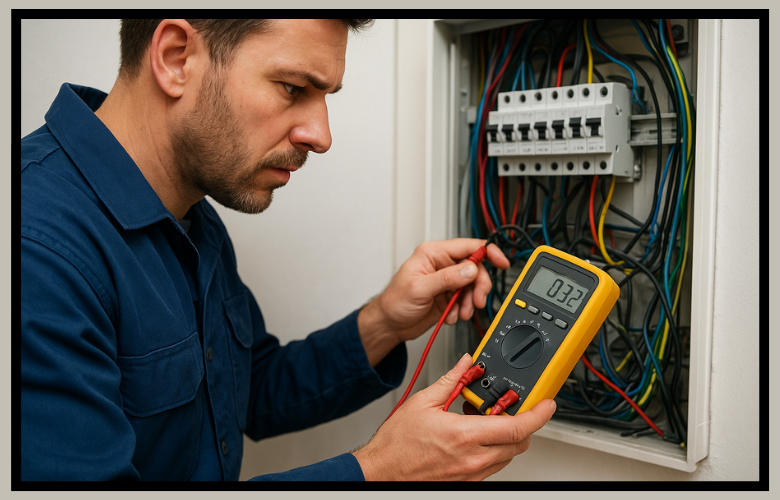
From heat pumps and electric vehicles to automated warehouses and data centres, Britain is becoming more dependent on electrical equipment that must operate safely for long periods. Much of that safety rests on something most people never see: the insulation that keeps current confined to its intended path. An Insulation Resistance Test gives engineers and maintenance teams a practical way to assess that hidden barrier before deterioration becomes a costly or dangerous fault.
The basic idea is straightforward. A test instrument applies a known voltage between conductors, or between a conductor and earth, and measures the small current that passes through the insulating material. Using Ohm’s law, the instrument converts that current into a resistance value, normally expressed in megohms or gigohms. Higher resistance indicates that the insulation is doing its job; a lower or unstable reading can suggest moisture, contamination, thermal aging, mechanical damage, or another developing weakness.
Why Insulation Deteriorates
Electrical insulation is robust, but it is not immortal. Repeated heating and cooling can make materials brittle. Vibration can rub cables against metalwork. Dust and conductive deposits can form leakage paths across terminals. In the British climate, condensation is a particular concern in plant rooms, outdoor enclosures, workshops and buildings that are intermittently heated. Even equipment that appears perfectly sound from the outside may be changing electrically on the inside.
This is why a single visual inspection cannot tell the whole story. Insulation resistance testing can help reveal gradual changes, especially when readings are recorded consistently and compared over time. A downward trend may be more informative than one isolated number. It allows maintenance teams to investigate, clean, dry, repair, or replace equipment in a planned way rather than after an unexpected shutdown.
Why Does the Test Use DC Voltage?
A common question is why insulation resistance instruments apply direct current rather than ordinary mains-frequency alternating current. The concise answer is that DC makes it easier to measure the resistance component of the insulation. Kikusui’s technical FAQ, Insulation Resistance Test , explains that the purpose is to detect insulation failure by measuring the resistance of the device under test.
Insulated equipment also has capacitance. When a DC test voltage is first applied, a charging current flows, but it falls as the capacitance charges. After the appropriate settling period, the remaining current provides a clearer basis for evaluating insulation resistance. With AC, capacitive current continues to flow and can obscure the resistive leakage that the test is intended to measure. That does not make AC testing unimportant; withstand-voltage or dielectric-strength tests serve a different purpose. The key is to use the right test for the question being asked.
Where the Test is Used
The method is relevant across an unusually broad range of British infrastructure. Facilities teams may use it on fixed wiring, motors, pumps, heaters, and distribution equipment. Manufacturers can include it in end-of-line safety checks for appliances and electronic products. Rail, marine, energy and aerospace organisations may apply it to cables, assemblies and components exposed to demanding environments. Renewable-energy installations also depend on reliable insulation across inverters, storage systems, and associated cabling.
In production environments, programmable testers can make the process more repeatable. Test voltage, rise time, duration, and pass/fail limits can be controlled, while results can be stored or transferred to a wider quality system. This is particularly useful where traceability is required, or several product variants share the same test station.
Good Testing is More Than Pressing a Button
High-voltage testing must be treated with respect. The equipment should be isolated from its normal supply, and stored energy must be safely discharged after the test. Leads, fixtures, interlocks and guarding should be suitable for the voltage involved. The chosen test voltage and acceptance criteria should come from the relevant product standard, manufacturer guidance, or an approved engineering procedure rather than guesswork.
Conditions matter too. Temperature and humidity can influence results, as can surface cleanliness and the length or arrangement of test leads. For useful trend data, organisations should aim to repeat tests under comparable conditions and document any important differences. A surprising result should prompt investigation, not an immediate assumption that the asset has failed.
A Small Measurement with a Large Role
Insulation resistance testing is not glamorous, but it supports many of the technologies on which a lower-carbon, more automated Britain depends. It helps manufacturers verify workmanship, gives maintenance teams earlier warning of deterioration, and supports safer decisions about whether equipment should remain in service.
As electrical systems become more powerful and interconnected, hidden weaknesses carry greater consequences. A disciplined testing programme turns insulation from an unseen assumption into a measurable part of quality and reliability—exactly the sort of quiet engineering that keeps modern life moving.