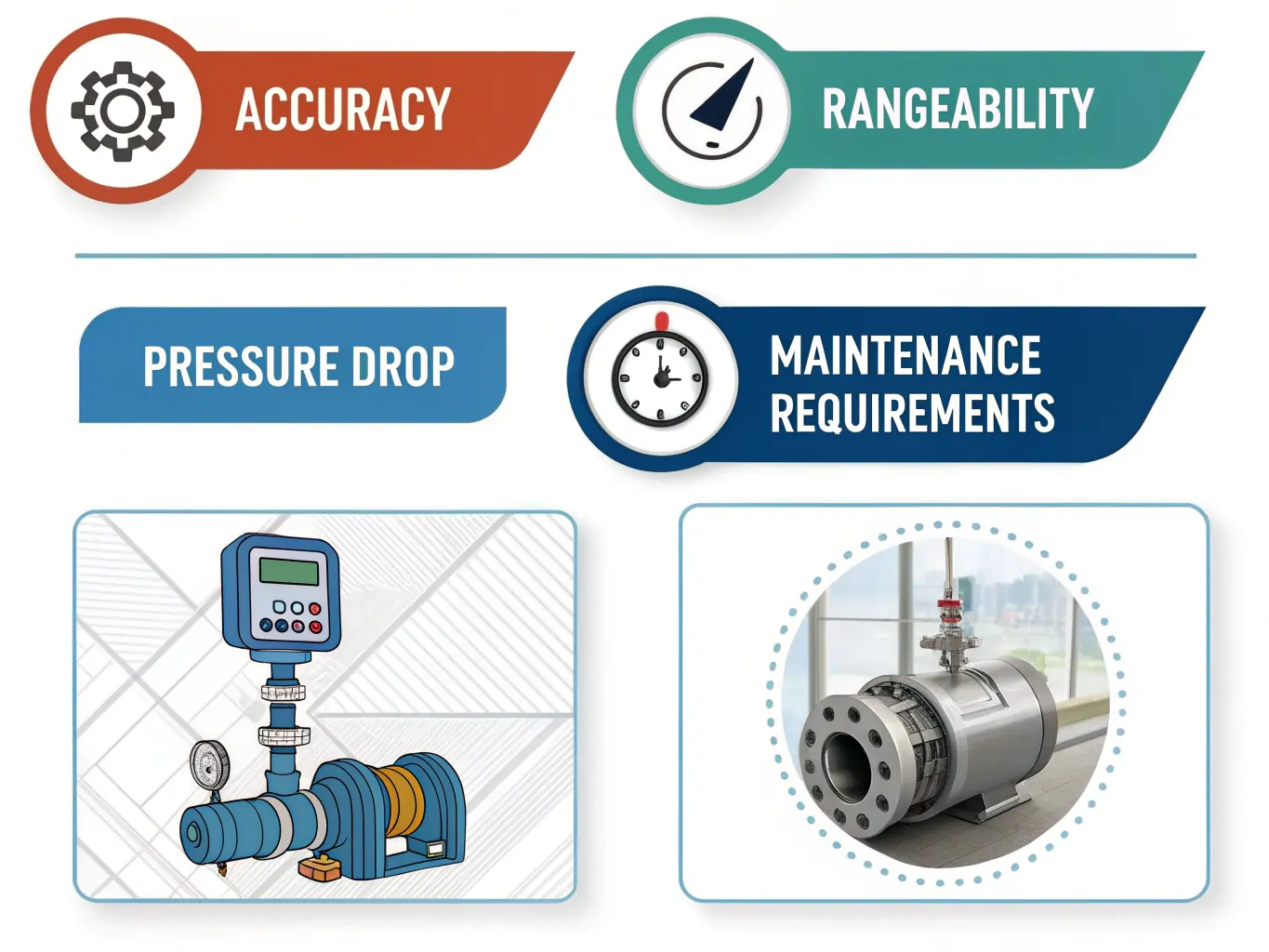
Hero Section (Bullet Summary):
✔️ Match the meter to your fluid — Know how properties like viscosity, conductivity, and temperature impact your meter choice.
✔️ Precision where it counts — Understand which specs matter most: accuracy, turndown ratio, and resolution.
✔️ Avoid common install issues — Learn how pressure drop, pipe layout, and mounting constraints can affect performance.
✔️ Real-world guidance for real fluids — Whether you’re measuring oil, water, chemicals, gas, or slurry, get the practical pros/cons of each flow meter type.
✔️ Bonus tools included — Use our side-by-side comparison table, sensor illustrations, and selection checklist to make your final decision easier.
Why Flow Meter Selection Matters
Choosing the right flow meter isn’t just about getting a reading on a display — it’s about ensuring the entire process runs smoothly, efficiently, and reliably. I’ve seen plenty of cases where a poorly chosen meter led to major issues: bad dosing ratios, wasted materials, unnecessary shutdowns, or even equipment damage. That’s why selection matters.
An Endress Hauser flow meter, for example, can deliver highly precise and repeatable measurements — but only if it’s matched to the right application. If you’re working with conductive liquids, a magmeter from their lineup might be ideal. But try that in a non-conductive oil loop, and you’ll run into trouble. That mismatch ends up costing far more than the meter itself.
Parameter #1 — Fluid Type and Properties
Before you even start comparing models or specs, the first thing I check is what kind of fluid we’re dealing with. The type of media — whether it’s a liquid, gas, or steam — immediately narrows down your flow meter options.
For example, magnetic flow meters only work if the fluid is electrically conductive. That rules them out for oils or pure hydrocarbons, but makes them ideal for water, slurries, and chemical solutions. If I’m working with thick, viscous fluids — like syrup or heavy oils — I lean toward Coriolis meters, which handle density and viscosity variations without breaking a sweat.
Other fluid properties matter too:
- Viscosity can throw off turbine and vortex meters.
- Temperature extremes can affect sensor performance and housing material — you’ll need to double-check rating limits.
- Chemical compatibility matters in aggressive media; you might need PTFE linings or stainless-steel components.
Even with gases, you need to think beyond “it’s just air.” Flowing nitrogen in a cleanroom setup behaves very differently than steam in a boiler line. Choose wrong, and you’ll end up with drift, signal loss, or worse — sensor failure within weeks.
So when someone asks, “Which flow meter should I use?” — my first question is always, “What exactly are you measuring?”
Parameter #2 — Flow Range and Velocity
One of the biggest mistakes I’ve seen in flow meter selection is overlooking the actual flow range the meter will experience in daily use. Every meter has a minimum and maximum flow rate where it performs within spec. If you operate below that minimum, expect noise, signal dropout, or zero readings. Go above the maximum? You’re risking turbulence, cavitation, and permanent damage.
That’s where turndown ratio comes in — the range over which a meter maintains accurate readings. A 20:1 turndown ratio means your meter can measure down to 5% of its max flow. For applications with wide fluctuations (like batching or variable-speed pumps), a high turndown ratio is a must.
Parameter #3 — Accuracy and Repeatability Requirements
Not every application needs 0.1% accuracy — but you’d better know when yours does.
There’s a big difference between accuracy (how close the measurement is to the real value) and repeatability (how consistent the reading is over time). For critical processes like custody transfer, chemical dosing, or batching systems, you can’t afford errors. I’ve worked with systems where a 1% drift meant thousands of dollars lost per week.
On the flip side, if you’re just monitoring flow trends or setting alarm thresholds in a cooling loop, ±2–3% accuracy may be perfectly acceptable — and much cheaper.
Also important: understand if accuracy is stated as % of full scale or % of actual reading. It makes a big difference, especially at low flow rates.
Parameter #4 — Pipe Size and Layout Constraints
It’s easy to choose a high-end flow meter on specs alone — until you realize it won’t fit the space you’ve got. That’s why pipe size and installation layout are just as important as fluid type or accuracy.
Depending on your system, you may be working with:
- Inline meters, which require cutting the pipe and flanging or threading
- Clamp-on ultrasonic meters, ideal for retrofits or hygienic lines
- Insertion probes, which slide into a tapped port and are great for large pipes
You also need to consider straight run requirements — some meters (like turbine or vortex) require 10–20 pipe diameters of straight pipe upstream and downstream for accurate readings. That’s not always available in tight skids or congested plants.
Parameter #5 — Pressure and Temperature Conditions
Your flow meter has to handle more than just flow — it also needs to withstand the pressure and temperature extremes of your system.
- High-pressure systems (like boiler feedwater or chemical injection) require sensors with robust housings, gasket seals, and tested pressure ratings.
- In high-temp lines, thermal expansion can affect mechanical integrity or cause sensor drift, especially in lower-cost meters.
- Steam lines demand rugged construction — this is where vortex flow meters often shine due to their minimal moving parts and ability to handle superheated vapor.
Also think long-term: thermal cycling (frequent heat-up/cool-down) puts more stress on sensor electronics and seals than constant temperature. Material compatibility matters too — especially with aggressive or hot fluids.
🔧 I’ve seen more than one plastic-bodied sensor crack under daily steam purges — always match pressure/temp ratings to your worst-case operating conditions.
Parameter #6 — Output Type and Integration
The output type of a flow meter determines how well it communicates with your control system. Get this wrong, and even the most accurate meter becomes a problem child.
You’ll typically choose between:
- Analog outputs like 4–20 mA or 0–10 V, common in legacy systems and simple flow loops.
- Digital outputs such as pulse (frequency) for batching, or protocol-based formats like HART, Modbus, or IO-Link.
When selecting, make sure the output:
- Matches your PLC or SCADA input capability.
- Supports the level of data granularity you need (instantaneous rate vs totalized flow).
- Can handle alarms, remote diagnostics, or configuration changes if needed.
🛠️ I’ve had setups where everything worked perfectly — until we realized the pulse output didn’t sync with our batch controller. Always map output format to your system’s input before buying.
Parameter #7 — Maintenance, Cleaning, and Calibration
You don’t just install a flow meter and walk away — not if you care about long-term accuracy.
Here’s what matters:
- Non-intrusive meters (ultrasonic clamp-on, mag meters) usually have no moving parts, so they’re low-maintenance.
- Mechanical meters like turbine or paddlewheel types require regular cleaning and are sensitive to debris and wear — especially in slurries or dirty media.
- CIP/SIP environments (clean-in-place/steam-in-place) in food or pharma demand meters that can handle thermal shock and residue buildup.
🔧 In my food plant installs, I favor Coriolis meters where budgets allow — not just for accuracy, but because they survive aggressive washdowns without constant recalibration.
Flow Meter Comparison Table (by Parameter)
When selecting a flow meter, engineers often face multiple trade-offs — cost vs accuracy, install complexity vs maintenance effort, or fluid compatibility vs long-term stability. This comparison table brings clarity by breaking down five common flow meter types across the parameters that matter most.
It’s not about choosing the “best” meter — it’s about choosing the right one for your fluid, process conditions, and measurement goals.
| Parameter | Coriolis | Magnetic | Vortex | Turbine | Ultrasonic |
| Fluid Compatibility | Liquids, slurries, some gases | Conductive liquids only | Liquids, steam, gases | Clean liquids only | Liquids, gases (incl. non-conductive) |
| Accuracy | ±0.1% or better | ±0.2–0.5% | ±0.5–1% | ±0.5–1% | ±0.5–2% (depends on setup) |
| Best Applications | High-accuracy dosing, slurries, custody transfer | Water treatment, chemical dosing | Steam flow, compressed air, utility gases | Water, oils, simple batching | Retrofit, temporary installs, large pipes |
| Installation | Inline; requires stable mounting | Inline; needs grounding | Inline; needs straight pipe runs | Inline; sensitive to flow profile | Clamp-on or inline; easy for retrofits |
| Moving Parts | No | No | Yes (vortex shedding) | Yes (mechanical rotor) | No |
| Maintenance | Low, clean-in-place capable | Very low | Medium; debris can affect performance | High; sensitive to dirt, wear | Low; occasional cleaning of transducers |
| Pressure Drop | Moderate | Very low | Medium | High | None (clamp-on); Low (inline) |
If you’re metering a conductive liquid and want simple wiring and low maintenance, magnetic flow meters are often ideal. But if you’re dealing with non-conductive fluids, large retrofit pipelines, or custody transfer, ultrasonic or Coriolis might be your go-to.
🛠️ In my experience, turbine meters are fine for clean water lines — but anything with particles or viscosity? I’ll go Coriolis or mag to avoid breakdowns and recalibration headaches.
Let me know if you want this visualized as a downloadable chart or included in a maintenance guide.
How I Choose Flow Meters in the Field (Engineer Advice)
When I’m selecting a flow meter on-site, it’s rarely a one-size-fits-all decision. Every system comes with its own constraints — budget, fluid type, space, and reliability expectations. Here’s how I typically approach it in real-world scenarios:
Batching Chemicals in a Skid System
For precise dosing of chemicals in small-batch production, accuracy and repeatability are everything. I go with Coriolis flow meters because they provide true mass flow, handle varying fluid densities, and have no moving parts to clog or wear. Yes, they’re expensive — but one misdose can ruin an entire batch, so it pays off quickly.
Monitoring Wastewater Output
In municipal or industrial wastewater, fluids are often dirty, full of suspended solids, and highly variable in conductivity. That’s where magnetic flow meters shine — they’re reliable, maintenance-friendly, and accurate enough for regulatory reporting. I always double-check that the fluid is conductive, though — a rookie mistake I learned the hard way years ago.
Chilled Water Systems in HVAC
For chilled water or cooling loops, especially in retrofits, I often recommend ultrasonic clamp-on meters. They’re non-intrusive, quick to install, and cause zero pressure drop. If space is tight or the system can’t be shut down, clamp-on saves a ton of time and cost. Just make sure the pipe is clean and the transducers are aligned properly.