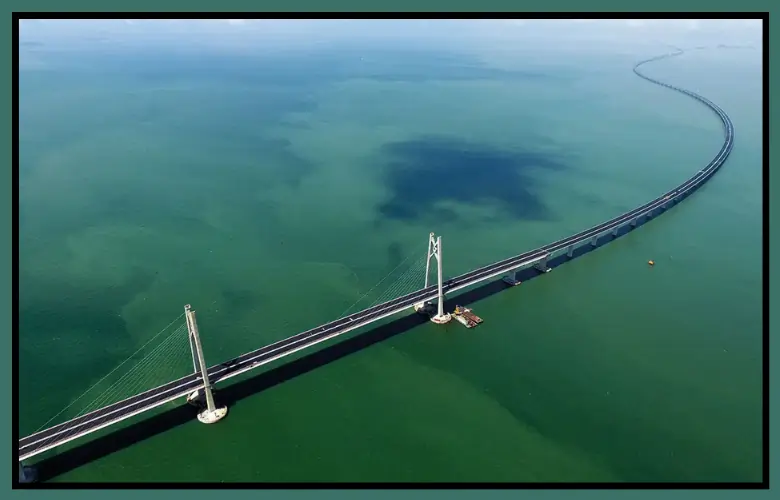
One of the most magnificent feats in the field of engineering that has been accomplished by the help of cutting-edge technology and human intellect is the world’s longest bridge. Designed for facilitating high-speed rail transit, the bridge has efficiently connected various cities separated by rivers, marshlands, agricultural land, and urban areas. This gigantic engineering work greatly contributes to increasing the speed and safety of transport for many people annually. In addition to being a transport link, it is also an important landmark reflecting the development of economy and infrastructure. The design of this bridge has attracted the attention of engineers from all around the world.
What Is the Longest Bridge in the World?
The longest bridge in the world is the Danyang–Kunshan Grand Bridge, which is located in Jiangsu Province, China. It forms an important part of the Beijing–Shanghai High-Speed Railway, one of the busiest railway routes in the country.
This bridge stretches across many types of terrain. For example, it crosses rivers, lakes, rice fields, wetlands, and even urban areas. Because of this mixed landscape, engineers did not build a simple bridge. Instead, they created a long elevated viaduct system that allows trains to travel smoothly without interruption.
Construction started in 2006 and finished in 2010. After that, the bridge officially opened in 2011. Thousands of workers and engineers contributed to the project. As a result, it became one of the largest and most complex infrastructure projects ever completed.
Why the Longest Bridge Was Built
The main purpose of this bridge was to improve high-speed rail travel between major cities in China. Before its construction, trains had to slow down when crossing uneven ground and natural obstacles. Therefore, travel times were longer and less efficient.
To solve this problem, engineers designed a continuous elevated route. This design allowed trains to maintain high speed without stopping or slowing down. In addition, it improved safety and reduced wear on railway systems.
The bridge also helped in other important ways:
- It reduced travel time between major cities
- It improved safety for high-speed trains
- It protected farmland and natural landscapes
- It created a direct and efficient rail connection
Because of these benefits, the bridge became a key part of national transportation planning.
Engineering Design and Structure
The engineering design of the bridge is highly advanced. Engineers used reinforced concrete and steel to build a strong and durable structure. These materials helped the bridge handle heavy loads and resist environmental stress.
In addition, thousands of support pillars were installed across different terrains. Engineers placed each pillar carefully to ensure balance and stability. As a result, the entire structure supports high-speed trains without vibration or instability.
Moreover, the design accounts for natural forces such as earthquakes, strong winds, and temperature changes. Engineers included flexible joints and expansion gaps so the structure can move slightly without damage. Therefore, the bridge remains stable under different conditions.
Construction Process and Challenges
The construction process was extremely complex. However, engineers managed it through careful planning and coordination. Different teams worked on multiple sections at the same time, which helped speed up the project.
At the same time, the project faced several challenges. For example, some areas had soft soil, while others included deep water or wetlands. Because of this, engineers had to design special foundations for stability.
To solve these problems, they used modern tools such as GPS systems, laser alignment, and digital surveying equipment. As a result, they achieved precise alignment across the entire structure. Eventually, the project was completed in just four years, which is very fast for such a large-scale bridge.
Importance in Modern Transportation
Today, the bridge plays a major role in China’s high-speed rail network. It supports daily train operations between Beijing and Shanghai. Therefore, millions of passengers use it every year.
The bridge improves transportation in several ways:
- It allows fast and uninterrupted train movement
- It reduces delays and improves reliability
- It increases passenger capacity on major routes
- It strengthens national transport efficiency
In addition, passengers experience smoother and more comfortable journeys. Because of this, high-speed rail has become a popular travel choice.
Economic and Environmental Benefits
The bridge also brings strong economic benefits. It connects major business and industrial regions, which helps increase trade and tourism. As a result, local economies grow faster and more efficiently.
Furthermore, the bridge reduces environmental impact. Instead of cutting through farmland or natural areas, it rises above the ground. Therefore, it protects ecosystems and reduces land disruption.
In addition, it supports sustainable transportation by encouraging people to use trains instead of cars or airplanes for long-distance travel.
Real-Life Usage and Daily Impact
The bridge is used every day by high-speed trains. These trains carry business travelers, tourists, and daily commuters. Because of its design, trains move quickly and safely across long distances.
Its real-life impact is significant:
- It connects major cities efficiently
- It saves travel time for millions of people
- It improves daily commuting experience
- It supports economic activity across regions
Therefore, it is not just an engineering project but a practical part of everyday life.
Pros and Cons of the World’s Longest Bridge
The bridge offers many advantages. It improves speed, safety, and connectivity. In addition, it supports economic growth and strengthens the national railway system.
However, it also has some challenges. The project required a very high investment. Moreover, construction was complex because of different terrains such as rivers, wetlands, and farmland. Even today, engineers must perform regular maintenance to ensure long-term safety.
Despite these challenges, the benefits are much greater than the disadvantages. Therefore, it is considered a highly successful infrastructure project.
Comparison with Other Famous Bridges
Many famous bridges around the world are known for their beauty or historical value. However, this bridge is different because it focuses on function and performance.
Unlike traditional suspension bridges, it does not aim to be a tourist attraction. Instead, it focuses on efficiency and transportation speed. Therefore, it represents a modern approach to infrastructure design.
As a result, it stands out as one of the most important engineering projects in the world.
Future Importance of Mega Infrastructure Projects
This bridge continues to influence future engineering projects. Many countries study its design when planning high-speed rail systems.
In the future, similar projects may focus on:
- Faster transportation systems
- More sustainable construction methods
- Better environmental protection
- Improved large-scale planning techniques
Therefore, this bridge will continue to shape global infrastructure development for many years.
(FAQs)
1. What is the longest bridge in the world?
The longest bridge in the world is the Danyang–Kunshan Grand Bridge, which is part of the Beijing–Shanghai High-Speed Railway in China.
2. Where is the longest bridge located?
It is located in Jiangsu Province, eastern China, stretching across rivers, lakes, wetlands, farmland, and urban areas.
3. Why was the bridge built?
It was built to improve high-speed rail connectivity, reduce travel time between major cities, and ensure smooth transportation across difficult terrain.
4. How long did it take to build the bridge?
Construction took approximately four years, from 2006 to 2010, involving thousands of engineers and workers.
5. Is the bridge used for public transport today?
Yes, it is actively used by high-speed trains every day as part of China’s major railway network.
Conclusion
The world’s longest bridge is an amazing example of engineering marvels, innovation, and infrastructure planning on a grand scale. It has revolutionized transportation in terms of providing a safe and speedy way for high-speed railway traffic. It not only promotes economic development and regional development but also makes the life of millions of travelers easier. Despite its very high cost and difficult engineering process, the advantages of this project will continue to prevail over the problems that are faced. It is one of the most incredible infrastructural projects ever constructed.