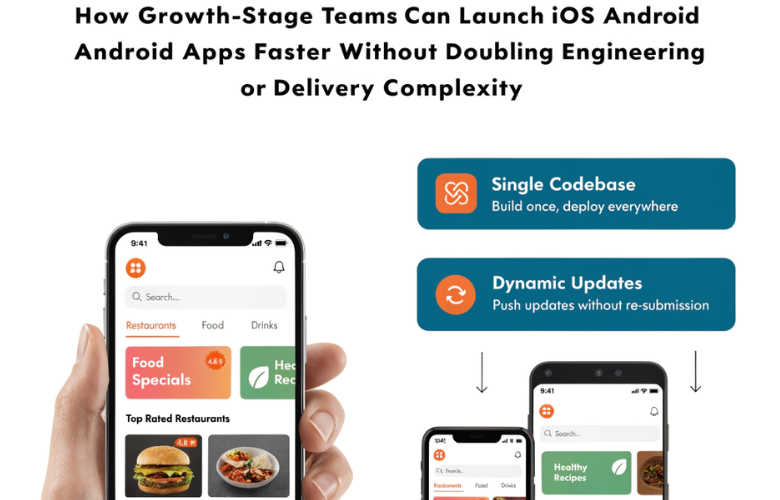
Enterprise mobile teams do not miss deadlines because engineers lack skill. They miss them because the delivery model creates duplicate work. One team builds for iOS. Another is built for Android. QA repeats the same business flows twice. Release coordination grows into its own workload. What starts as platform coverage turns into cost expansion.
That pattern breaks down faster in large organizations. Product teams need a consistent customer experience across channels. Platform teams need secure integrations, stable APIs, and reliable release governance. Leadership needs faster launches without asking for another full layer of headcount. This is why many organizations now review shared architecture and delivery models through partners that offer Mobile App Development Services.
The business logic behind this shift is simple. When two teams solve the same feature set in parallel, delivery slows before cost becomes visible. Product managers negotiate parity instead of shaping roadmap value. Engineering managers absorb dependency friction. Platform teams support separate release paths that drift over time.
Sensor Tower reported that mobile users spent 4.2 trillion hours in apps in 2024, and consumer spending reached $150 billion, which shows how costly delayed mobile execution has become for product-led organizations. (Clutch)
Where The Traditional Mobile Model Loses Time
The old model appears safe because it mirrors native platform boundaries. In practice, it spreads one roadmap across two engineering systems.
A login overhaul can require duplicate frontend work, duplicated test coverage, duplicated release signoff, and separate bug-fix cycles. Once security review, analytics tagging, and backend integration are added, the effort multiplies again. At enterprise scale, that duplication compounds across product lines, regions, and internal stakeholder groups.
The issue is not only technical. It is operational. Separate teams often maintain different component libraries, different release habits, and different interpretations of design standards. That creates slower launches and weaker predictability.
This is why more engineering leaders now frame mobile as a platform problem rather than a staffing problem. They want one delivery engine where shared business logic, shared design systems, and shared release controls reduce repeated effort. In that model, native work still matters, but it becomes targeted rather than default.
Why Unified Mobile Engineering Has Become A Practical Priority
Cross-platform delivery no longer sits in the experimental category for enterprise teams. Mature frameworks support native modules, strong performance, and integration patterns that fit modern cloud environments. The strategic advantage comes from where teams apply standardization.
A unified codebase does not remove every platform-specific decision. It removes the need to rebuild the same customer journey twice. That changes how teams plan releases, test features, and allocate engineering capacity. It also creates a cleaner path for design consistency and analytics governance.
This matters because capacity remains tight even in large engineering organizations. Teams can add people and still lose speed if the operating model stays fragmented. That is why some enterprises choose to hire React Native Developers when they need faster execution without creating another parallel mobile unit.
The strongest teams put guardrails around this model. They define what stays shared, what stays native, and who owns platform standards. A central mobile platform function often manages architecture, component libraries, and release discipline. Product teams then move faster because the foundation stays stable.
What Decision-Makers Should Look For Before Committing
Leaders should assess three issues before they modernize mobile delivery.
First, they should examine where duplication actually lives. In many cases, the biggest drag sits in QA, release governance, or design drift rather than in coding hours alone.
Second, they should review where native specialization still matters. Hardware-heavy features, advanced animations, and deep platform integrations may justify targeted native modules even inside a shared architecture.
Third, they should test whether a partner understands enterprise constraints. A vendor that only talks about frameworks will struggle with compliance reviews, dependency management, phased migration, and cross-team governance.
Clutch says its rankings and research factors rely heavily on verified client reviews, along with market presence and service focus, which makes it a useful starting point for comparing firms in this space. (Clutch)
5 U.S. Technology Partners Enabling Faster Cross-Platform Mobile Delivery
1. GeekyAnts
GeekyAnts is a global technology consulting firm specializing in digital transformation, end-to-end app development, digital product design, and custom software solutions. It fits enterprise teams that need cross-platform delivery tied to broader platform modernization rather than isolated app builds.
Clutch currently lists GeekyAnts at 4.9 from 113 verified reviews. GeekyAnts Inc, 315 Montgomery Street, 9th and 10th floors, San Francisco, CA 94104, USA. Phone: +1 845 534 6825. Email: info@geekyants.com. Website: www.geekyants.com/en-us.
2. Saritasa
Saritasa works across custom software, mobile, and immersive product delivery. It is relevant for enterprises that need mobile applications tied to operational systems, regulated workflows, or complex service environments.
Clutch currently lists Saritasa at 4.8 from 103 verified reviews. 19900 MacArthur Blvd, Suite 650, Irvine, CA 92612, USA. Phone: 888 646 2688.
3. Red Foundry
Red Foundry focuses on digital product strategy, UX, and mobile engineering. It suits organizations that want a tighter link between product planning and app execution without relying on a pure staff-augmentation model.
Clutch currently lists Red Foundry at 4.8 from 45 verified reviews. Chicago, Illinois, USA. Phone: 888 406 1099.
4. ArcTouch
ArcTouch remains a credible option for enterprises that care about customer-facing product design as much as delivery execution. Its relevance is strongest where mobile apps support brand experience, connected products, or multi-platform product ecosystems.
Clutch currently lists ArcTouch at 4.9 from 37 verified reviews. 548 Market Street, San Francisco, CA 94104, USA. Phone: +1 415 944 2000.
5. Dogtown Media
Dogtown Media focuses on mobile product development with a strong presence in healthcare, wellness, and emerging technology use cases. It is relevant for enterprise teams that need a specialist partner for customer apps where compliance, user engagement, and iterative release cycles matter.
Clutch currently lists Dogtown Media at 4.7 from 30 verified reviews. Venice, Los Angeles, California, USA.
Final Thoughts
The core mobile delivery problem is not a shortage of frameworks. It is a shortage of operating models that reduces repeated work. Growth-stage enterprises do not need two full engineering motions for one product strategy if they can standardize architecture, tighten release governance, and isolate native work where it creates clear value.
That is why the most effective next step is often not a platform rewrite. It is a focused assessment of where delivery friction lives today. For many teams, that review reveals whether the slowdown comes from architecture, org design, or release process. Once that is clear, faster iOS and Android delivery becomes a structural decision rather than a staffing gamble.